
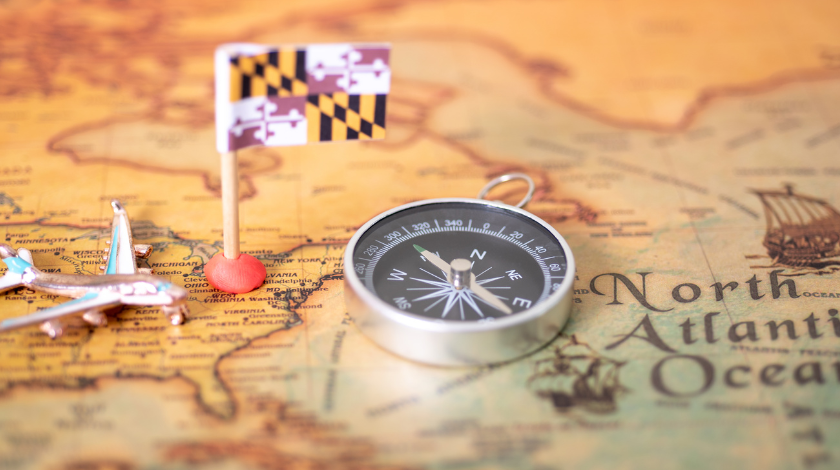
If you have ever driven through the state of Maryland, or perhaps watched a University of Maryland football game, you have seen it. It is bold. It is bright. It is, quite frankly, a little bit chaotic. I am talking about the Maryland state flag. To an outsider, the design might look like a medieval shield or perhaps a high-fashion pattern gone wild. But to a Marylander, that flag is a badge of honor. It is one of the only state flags in America that people actually want to wear on their clothes. In my opinion, it is the most distinct and beautiful flag in the country, and it has a story that is just as complex as its pattern.
To understand why the Maryland flag looks the way it does, we have to travel back in time to the 1600s. Unlike most state flags that were designed in the late 19th or early 20th centuries, Maryland’s design is rooted in ancient English heraldry. It is based on the coat of arms of the Calvert family, who were the Lords Baltimore and the founders of the Maryland colony. This connection to the “Old World” gives the flag a sense of history that many other states lack. When you look at the flag, you are actually looking at two different family legacies woven together into one single banner.

The flag is divided into four quarters. The first and fourth quarters feature the black and gold pattern of the Calvert family. George Calvert, the first Lord Baltimore, was given this coat of arms as a reward for his service to the British Crown. The design consists of six vertical bands of gold and black with a diagonal band where the colors are reversed. It is a striking look that was meant to show off the family’s status and power. In the early days of the colony, this black and gold pattern was often called the Maryland colors, and it was used long before the current flag was officially adopted.
The second and third quarters of the flag are where things get even more interesting. These sections feature a red and white “cross bottony” design. This comes from the Crossland family, which was the family of George Calvert’s mother. In the world of heraldry, if a man’s mother was an heiress, he could include her family’s coat of arms in his own. This is why we see the red and white crosses alongside the black and gold bars. The cross bottony is unique because the ends of the cross look like trefoils or little flowers. It adds a layer of elegance to the otherwise bold and geometric design of the Calvert side.
However, the flag we see today was not always the unified symbol of the state. In fact, for a long time, the two designs were used to represent different political leanings, especially during the American Civil War. This is a part of history that many people do not realize. Maryland was a border state, which means it stayed in the Union, but many of its citizens sympathized with the Confederacy. During the war, Union soldiers from Maryland often used the black and gold Calvert colors. Meanwhile, Marylanders who went south to fight for the Confederacy adopted the red and white Crossland colors as a way to distinguish themselves.
After the Civil War ended, Maryland was a state deeply divided by the conflict. There was a lot of pain and anger on both sides. In the late 1800s, people began looking for ways to heal those wounds and bring the state back together. One of the ways they did this was by combining the black and gold Calvert colors with the red and white Crossland colors into one single flag. This “reconciliation flag” was first flown in 1880 to celebrate the 150th anniversary of the founding of Baltimore. It was a powerful message: even though we were once divided, we are now one people under one banner. The flag was officially adopted by the state legislature in 1904.
One thing I have always found fascinating about Maryland is the sheer level of pride people have in their flag. If you go to Texas, you see the Lone Star flag everywhere. If you go to Maryland, you see the flag on everything. It is on car decals, t-shirts, sunglasses, coffee mugs, and even tattooed on people’s arms. There is a joke that if you stand still long enough in Annapolis, someone will paint the Maryland flag on you. This pride likely comes from the fact that the design is so visually unique. Most state flags are just a blue background with a state seal in the middle. They are hard to tell apart from a distance. Maryland’s flag, on the other hand, is impossible to miss. It stands out in a crowd, and that makes people feel like they belong to something special.
The Maryland flag is also a major part of the state’s sports culture. Under Armour, a massive sports brand founded by a Maryland alumnus, has used the flag’s design in various high-profile uniforms for the University of Maryland. These uniforms often feature the bold patterns on the helmets and shoulders. While some people think the look is too loud, I think it is a brilliant way to showcase local identity. It turns a piece of cloth into a brand that represents grit, history, and modern style. It is not just a flag; it is a lifestyle.
When it comes to flying the Maryland flag, there are some very specific rules you should follow. These are not just suggestions; they are part of the state’s official protocol. For example, if you are flying the Maryland flag on the same pole as the United States flag, the U.S. flag must always be at the top. If the Maryland flag is flown alone, the “black stripe” of the Calvert design should be at the top near the flagpole. There is also a rule about the “ornament” or the topper of the flagpole. In Maryland, it is traditional to use a gold cross bottony as the finial on top of the pole. This is a direct nod to the red and white cross in the flag’s design.
From a design perspective, the Maryland flag follows many of the rules of good flag design, but it also breaks some of them. Most flag experts say a flag should be simple enough for a child to draw from memory. If you ask a child to draw the Maryland flag, they will probably struggle with the intricate crosses and the specific number of bars. However, despite its complexity, it is highly recognizable. It uses a limited color palette of four colors that contrast perfectly. The gold and black provide a heavy, grounded feeling, while the red and white add a sense of movement and brightness. It is a masterclass in balance.
I remember talking to a friend from the West Coast who saw the Maryland flag for the first time. He asked me, “Why does your flag look like a racing signal or a warning sign?” I laughed because, in a way, he was right. It does have an urgent, high-energy feel to it. But once I explained the history of the Lords Baltimore and the way the state healed after the Civil War, he started to see the beauty in it. It is not just a random collection of shapes. Every line and every color tells the story of a family that crossed an ocean to start a new life, and a state that survived the darkest chapters of American history to come out stronger on the other side.
If you are a student of history or just someone who appreciates good art, the Maryland flag is worth studying. It represents the concept of E Pluribus Unum (Out of many, one) on a state level. It brings together English tradition and American resilience. It manages to be both ancient and modern at the same time. Whether you see it flying over the State House in Annapolis or printed on a can of Old Bay seasoning, it serves as a reminder that Maryland is a place with a deep soul and a very loud sense of style.
In conclusion, the Maryland flag is more than just a state symbol. It is a piece of living history that connects the modern residents of the “Old Line State” to their colonial ancestors. Its design is a testament to the power of reconciliation and the importance of heritage. While other states might be content with simple designs, Maryland embraces its complexity. It is bold, it is colorful, and it is uniquely Maryland. If you ever have the chance to see it waving in the breeze on a sunny day in the Chesapeake Bay, you will understand why so many people hold it in such high regard. It is truly a flag like no other.
Conclusion
The Maryland state flag stands as a pinnacle of American heraldry and state pride. By blending the Calvert and Crossland family crests, the flag tells a story of colonial ambition, civil war division, and eventual healing. Its popularity in modern culture proves that a well-designed symbol can transcend politics and become a beloved part of a community’s identity. Whether you are a historian, a designer, or just a proud Marylander, the flag offers a rich tapestry of meaning that continues to inspire.
Frequently Asked Questions (FAQ)
1. What do the colors of the Maryland flag represent?
The black and gold colors represent the coat of arms of the Calvert family (the Lords Baltimore). The red and white colors represent the coat of arms of the Crossland family (Lord Baltimore’s mother’s family). Together, they symbolize the ancestry of the state’s founders.
2. Is the Maryland flag the only state flag based on British heraldry?
While many state flags have elements influenced by European designs, Maryland’s flag is unique because it is a direct representation of two specific family coats of arms, making it one of the most traditionally heraldic flags in the United States.
3. Why did the Maryland flag change after the Civil War?
Before the war, only the black and gold Calvert colors were commonly used. During the war, the red and white Crossland colors were used by those siding with the Confederacy. After the war, the two designs were combined into one flag to symbolize the reunification of the state.
4. What is the cross on the Maryland flag called?
The cross in the red and white sections is called a “cross bottony.” It is characterized by the three-leaf (trefoil) shape at the end of each arm.
5. Can I wear the Maryland flag on my clothes?
Yes! Marylanders are famous for putting their flag on everything from socks to jerseys. There are no laws against wearing the flag design on apparel, and it is a popular way to show state pride.