
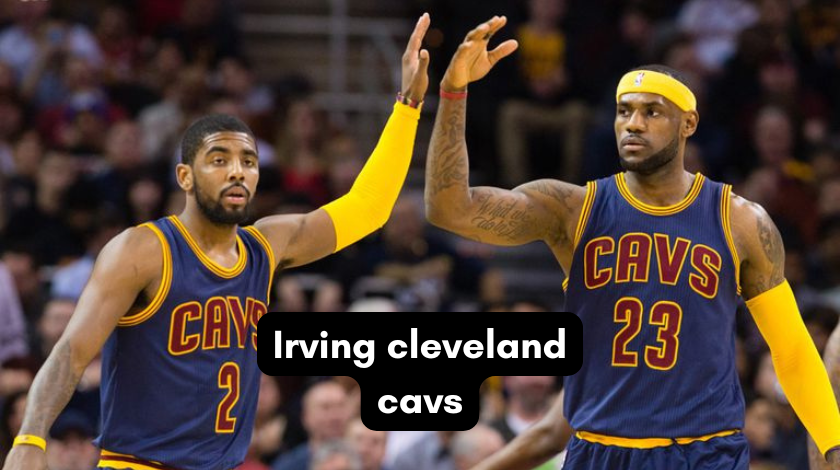
If you close your eyes and think about the most important moment in the history of Cleveland sports, you see one thing. You see a black jersey, the number 2, and a high-arcing basketball falling through a net at Oracle Arena. That moment, known simply as “The Shot,” did not just win a basketball game. It lifted a curse that had plagued a city for over fifty years. The man who took that shot was Kyrie Irving. His relationship with the Cleveland Cavaliers is one of the most complex, exciting, and confusing stories in modern NBA history. It is a story that has everything a movie script would need. There is a young hero, a returning king, a seemingly impossible enemy, and a messy breakup that left everyone wondering what went wrong.
To truly understand Kyrie Irving’s time in Cleveland, you cannot just look at the box scores. You have to understand the emotion behind it. He went from being the solitary bright spot on a terrible team to being a champion, then to a villain who demanded a trade, and finally, he settled into the status of a complicated legend. For fans in Northeast Ohio, Kyrie represents the highest of highs and some baffling lows. But no matter how much time passes, or how many other teams he plays for, his legacy is tied permanently to the wine and gold. This is the story of how a kid from New Jersey became the Prince of Cleveland.
The Savior Arrives (2011-2014)
You have to remember the context of the Cleveland Cavaliers in 2011 to understand how important Kyrie Irving was. The year prior, in 2010, LeBron James had left for the Miami Heat on national television. It devastated the city. The team went from being a championship contender to setting a record for the most consecutive losses in a single season. The franchise was depressing. The arena was empty. There was absolutely no hope. Then came the NBA Draft lottery. Despite the odds, the Cavaliers won the first overall pick. They selected Kyrie Irving out of Duke University. He had only played 11 games in college because of a toe injury, so there were questions about his durability, but the talent was undeniable.
When Kyrie arrived, he was instantly the best player on the floor. He was only 19 years old, but he had a maturity to his game that veterans usually possess. He won the Rookie of the Year award in a landslide. During those first three years, from 2011 to 2014, the Cavaliers were still a bad team. They lost a lot of games. But for the fans who tuned in, Kyrie was the “Savior.” He was the reason you bought a ticket. I remember watching games during that era where the Cavs would be down by 20 points, but fans stayed just to see Kyrie perform a crossover or a spin move that didn’t seem physically possible. He was affectionately known as “Uncle Drew” during this time due to his famous Pepsi commercials, and he brought a swagger back to a city that had its heart broken. He proved that Cleveland could still have star power, even without LeBron.
The Return of the King and The Big Three
The summer of 2014 changed the entire trajectory of Kyrie Irving’s career. LeBron James announced he was coming home. Suddenly, the Cavaliers were not just a rebuilding project; they were immediate title contenders. The front office traded for Kevin Love, creating a new “Big Three.” However, this transition was not seamless. In LeBron’s famous “I’m Coming Home” letter, he mentioned several teammates, but he initially left Kyrie’s name out of the main focus, which some people thought was strange. It was the first sign that there might be a power struggle. Kyrie had spent three years being the “Alpha dog,” taking every big shot and running the offense. Now, he had to adjust to playing alongside the most dominant player in the world.
The adjustment period was rocky. Early in the 2014-2015 season, there were reports of friction. Reporters asked questions about whether Kyrie could play off the ball. Being a point guard who needs to score is different from being a traditional playmaker. Kyrie had to learn how to be effective without dribbling the ball for 15 seconds of the shot clock. It took time, but they figured it out. Kyrie realized that playing with LeBron meant he would get open looks he never dreamed of before. LeBron realized that Kyrie was the best one-on-one scorer he had ever played with. They developed a “big brother, little brother” dynamic. It worked well enough to get them to the Finals in 2015, but Kyrie fractured his kneecap in Game 1, and the Cavs lost to the Warriors. That injury set the stage for the greatest redemption story in sports history the following year.
The 2016 NBA Finals: History Made
The 2016 NBA Finals is the series that will be talked about for as long as basketball is played. The Golden State Warriors were the defending champions. They had won 73 games in the regular season, breaking the record set by Michael Jordan’s Chicago Bulls. They were viewed as unbeatable. After four games, the Warriors held a 3-1 lead over the Cavaliers. No team in NBA history had ever come back from a 3-1 deficit in the Finals. The series looked over. The national media was already writing eulogies for the Cavs. But Kyrie Irving and LeBron James had other plans.
While everyone talks about Game 7, we cannot forget Game 5. The Cavs were playing in Oakland, facing elimination. In that game, Kyrie Irving played arguably the best game of his life. He scored 41 points on incredibly efficient shooting. LeBron also scored 41 points. It was the first time in Finals history that two teammates scored 40+ points in the same game. Kyrie was hitting shots from impossible angles. He was finishing over defenders, banking in fadeaways, and demoralizing the Warriors’ defense. That performance saved the season and shifted the momentum. The Cavs won Game 6 back in Cleveland, forcing a decisive Game 7.
“The Shot” Heard ‘Round the World
Game 7 was an ugly, gritty, defensive battle. For the last four minutes of the game, neither team could score. The score was stuck at 89-89. The tension in the arena was suffocating. Every possession felt like life or death. With just under a minute left on the clock, the Cavaliers had possession. They didn’t run a complicated play. They simply gave the ball to Kyrie Irving.
Kyrie found himself isolated on the right wing against Stephen Curry, the unanimous MVP of the league. Usually, a team would call for a screen to get a switch, but Kyrie waved everyone off. He wanted this moment. He dribbled between his legs, sizing Curry up. He did a quick stutter-step, a hesitation move that froze Curry for a split second, and then launched a side-step three-pointer.
I remember watching the ball in the air. It felt like it took ten years to come down. When it snapped through the net, the silence in the Oracle Arena was deafening, but back in Cleveland, millions of people screamed at the top of their lungs. The Cavs went up 92-89. That shot broke the Warriors’ spirit. It was the dagger. It remains the most clutch shot in the history of the franchise, and arguably one of the top five shots in NBA history. Because of that bucket, Cleveland won the title, and Kyrie Irving was immortalized.
Friction and the Desire for More
Winning a championship usually cures everything, but in Cleveland, the peace did not last long. After the high of the 2016 title, the Cavaliers returned to the Finals in 2017 but lost to the Warriors, who had added Kevin Durant. That summer, the cracks in the foundation completely broke open. Reports surfaced that Kyrie Irving felt like he was stagnating. He was tired of being the “little brother” to LeBron James. He felt that no matter what he did, LeBron would get the credit for the wins, and the team would get the blame for the losses.
Kyrie is a student of the game, and his idol was Kobe Bryant. Kobe famously wanted to win without Shaquille O’Neal to prove he could do it on his own. It seems Kyrie had that same “Mamba Mentality.” He wanted to find out how good he could truly be if he was the number one option, the leader of the franchise, and the face of the team. He didn’t want to live in LeBron’s shadow anymore. In July 2017, the news broke that Kyrie Irving had requested a trade. It shocked the basketball world. Why would anyone want to leave a team that was guaranteed to make the Finals every year? But for Kyrie, it was about more than just winning; it was about self-actualization and happiness.
The Trade That Changed the NBA
The Cavaliers’ front office was put in a terrible position. Their second-best player wanted out, and once that news is public, you lose leverage in trade negotiations. Eventually, in August 2017, the Cavaliers traded Kyrie Irving to the Boston Celtics. In return, the Cavs received Isaiah Thomas, Jae Crowder, Ante Zizic, and a draft pick that eventually became Collin Sexton.
At the time, people thought the trade might keep the Cavs competitive because Isaiah Thomas had just averaged nearly 29 points per game. However, it turned out to be a disaster for Cleveland. Isaiah Thomas had a severe hip injury and was never the same player. The chemistry on the Cavs fell apart. The trade effectively closed the championship window for the LeBron-era Cavaliers. Although LeBron dragged the team to the Finals one more time in 2018 through sheer force of will, they were swept by the Warriors. If Kyrie had stayed, history might have been very different. LeBron might have stayed in Cleveland longer, and they might have won another ring. That trade altered the landscape of the entire NBA for the next five years.
Looking Back: How Cleveland Views Kyrie Today
In the years immediately following the trade, the relationship between Kyrie Irving and Cleveland fans was toxic. When he returned to the Rocket Mortgage FieldHouse wearing a Celtics jersey (and later a Brooklyn Nets jersey), he was booed mercilessly. Fans held up signs calling him a traitor. It felt like a bitter divorce. Kyrie didn’t help matters, often making comments in the media that seemed to dig at the city or his former teammates.
However, time heals all wounds. We are now several years removed from that drama. The Cavaliers have successfully rebuilt their team with young stars like Donovan Mitchell and Darius Garland, which makes it easier for fans to let go of the past. The anger has started to fade, replaced by a sense of nostalgia. When you look back at the tapes, you don’t think about the trade request first. You think about the 57 points he dropped against the Spurs in an overtime win. You think about the buzzer-beaters. And most importantly, you think about The Shot.
There is a growing acknowledgment that without Kyrie Irving, there is no 2016 banner hanging in the rafters. LeBron James was the MVP, but Kyrie Irving was the closer. You cannot tell the story of the city’s triumph without him. The boos are getting quieter, and I believe that one day, they will turn back into cheers.
Conclusion
Kyrie Irving’s legacy in Cleveland is a tapestry woven with gold thread and dark clouds. He was the prodigy who gave us hope when we had none. He was the sidekick who helped slay the giant. And yes, he was the disruptor who forced his way out of town. But in the grand scheme of sports history, championships fly forever. The complications of his personality and his exit will eventually become footnotes, but the image of him holding that trophy with tears in his eyes will last forever.
For Cleveland fans, Kyrie Irving will always be the “Prince.” He wasn’t the King—that title belongs to LeBron—but he was royalty nonetheless. He brought a style, a flair, and a finishing ability that we may never see again. When his career is finally over and he hangs up his sneakers, I fully expect the Cavaliers to retire his number 2 jersey. It belongs in the rafters. He earned it with one flick of the wrist in June of 2016.
Frequently Asked Questions (FAQ)
1. What year did Kyrie Irving get drafted by the Cleveland Cavaliers?
Kyrie Irving was selected as the number one overall pick in the 2011 NBA Draft. He played for Duke University before joining the Cavaliers.
2. What are Kyrie Irving’s stats in the 2016 NBA Finals?
During the historic 2016 Finals, Kyrie Irving averaged 27.1 points, 3.9 rebounds, and 3.9 assists per game. He was incredibly efficient, shooting 46.8% from the field and 40.5% from three-point range.
3. Why did Kyrie Irving leave the Cleveland Cavaliers?
Kyrie requested a trade in the summer of 2017. The widely accepted reason is that he wanted to escape LeBron James’ shadow and establish himself as the primary leader and focal point of his own team.
4. Did Kyrie Irving and LeBron James get along?
Their relationship was complicated. While they had incredible on-court chemistry and respect for each other’s talents, there was friction regarding leadership roles and media attention. However, in recent years, both have spoken highly of their time together.
5. What is the “Uncle Drew” connection to Cleveland?
“Uncle Drew” is a character Kyrie Irving played in a series of Pepsi commercials that started during his early years in Cleveland. The character became so popular that it was eventually made into a feature film.
6. Will the Cavaliers retire Kyrie Irving’s jersey?
While it has not happened yet, it is widely expected that the Cavaliers will eventually retire Kyrie Irving’s number 2 jersey to honor his contributions to the 2016 NBA Championship.