
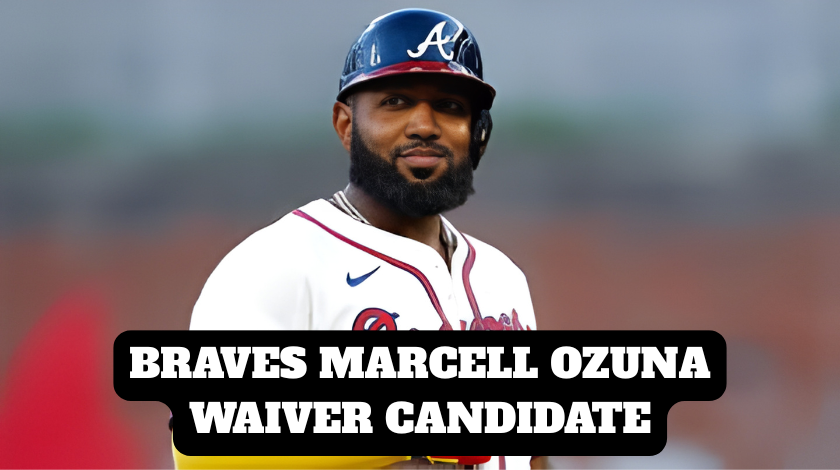
If you were following baseball chatter during the summer of 2025, you probably heard the phrase “Braves Marcell Ozuna waiver candidate” floating around sports radio, Twitter threads, and fan forums. The speculation got loud enough that casual observers might have assumed the veteran slugger was days away from being cut loose by the Atlanta Braves. But here is the thing about baseball roster moves: what fans and analysts speculate about often differs dramatically from what actually happens behind closed doors.
I have been covering MLB roster decisions for years, and I have learned that waiver talk usually signals something else entirely. Sometimes it is a team testing the market. Sometimes it is an agent floating possibilities. And sometimes it is simply the baseball ecosystem doing what it does best: creating drama during a long season. The Marcell Ozuna situation was a perfect storm of all three factors, wrapped in the reality of a disappointing Braves season and an aging designated hitter carrying a significant price tag.
By the time you finish reading this, you will understand exactly why the waiver rumors started, why they never materialized into action, and where Ozuna actually ended up. More importantly, you will see how this entire saga reflects broader truths about how modern baseball teams manage veteran contracts, evaluate declining performance, and balance financial flexibility against clubhouse stability.
What “Waiver Candidate” Actually Means in Baseball
Before diving into the Ozuna specifics, let me clear up some terminology that gets thrown around carelessly. When people say a player is a “waiver candidate,” they usually mean one of three things: the team might designate him for assignment (DFA), place him on release waivers, or try to pass him through outright waivers to remove him from the 40-man roster.
Here is the critical distinction that most fans miss: waivers are a procedural step, not a punishment. When a team places a player on waivers, it is essentially asking the other 29 teams whether they want to claim the player and assume his contract. If no one claims him, the original team can either send him to the minor leagues (if he has options) or release him (making him a free agent).
The term “waiver candidate” implies that a team is actively considering this route. In Ozuna’s case, the speculation suggested the Braves might try to dump his remaining 2025 salary to free up payroll space. The logic, as presented by analysts, went something like this: the Braves were out of playoff contention, Ozuna was having a down year, and his $16 million salary represented money better spent elsewhere in 2026.
But here is where reality diverges from speculation. The Braves never actually placed Ozuna on waivers. They never designated him for assignment. They never initiated any roster move that would have made him available to other teams through the waiver system. Instead, they played out the string, let his contract expire naturally at season’s end, and watched him walk into free agency. The “waiver candidate” label was always theoretical, never operational.
Why the Braves’ Marcell Ozuna Waiver Talk Started in 2025
To understand why the waiver narrative gained traction, you need to remember what the 2025 season felt like for Atlanta Braves fans. This was a team that had won six consecutive National League East titles. A team that had captured a World Series in 2021 and remained a perennial contender. A team with Ronald Acuna Jr., Matt Olson, and Austin Riley in their primes. Missing the playoffs was not just disappointing; it was unthinkable.
Yet by August 2025, the Braves were mathematically eliminated from contention. For the first time since 2017, October baseball would not feature the tomahawk chop. When teams collapse like this, front offices face uncomfortable questions. Every veteran contract becomes a target for scrutiny. Every underperforming player becomes a symbol of what went wrong.
Marcell Ozuna was an easy target for several reasons. First, his production had dropped noticeably from its peak. After hitting 40 home runs in 2023 and 39 in 2024, he managed just 21 in 2025. His batting average fell to .232, and his OPS dipped to .756. For a player whose primary value was offensive production, those numbers represented a significant decline.
Second, his contract was substantial. The Braves had exercised a $16 million club option for 2025, bringing his total guarantee to $65 million over four years. When a team is missing the playoffs, every dollar spent on underperforming veterans feels like a waste. Analysts calculated that waiving Ozuna might save a few million dollars in prorated salary, money that could theoretically be redirected to 2026 roster needs.
Third, Ozuna was strictly a designated hitter at this point in his career. He had not played the field since 2023 due to defensive limitations. When a team is rebuilding or retooling, a full-time DH carrying a $16 million price tag represents a luxury they might not afford. The waiver speculation fed on this logic: why pay premium prices for a one-dimensional player when you could rotate younger, cheaper options through the DH spot?
What Actually Happened: The Truth About Ozuna’s Status
Here is where I need to be absolutely clear, because misinformation still circulates about this situation. Marcell Ozuna was never placed on waivers by the Atlanta Braves. He was never designated for assignment. He was never released. He finished the 2025 season on the active roster, played his final game as a Brave, and walked away as a free agent when his contract expired.
The distinction matters for several reasons. When a player is waived or released mid-contract, it signals a breakdown in the relationship between the player and the team. It suggests the organization has given up on recouping any value. It often creates hard feelings and burned bridges. None of that happened with Ozuna.
Braves president of baseball operations Alex Anthopoulos explained the decision-making process in February 2026, after Ozuna had signed with another team. The organization viewed Ozuna as a professional who handled a difficult season with class. They recognized that his underlying skills remained intact despite the surface-level stat decline. And they determined that the financial savings from a waiver move would be minimal compared to the disruption it would cause.
This is the reality that gets lost in hot-take culture. Baseball front offices do not make roster decisions based solely on spreadsheets and public pressure. They factor in clubhouse dynamics, player reputation, and long-term organizational health. The Braves could have waived Ozuna in August 2025, saved a few million dollars, and dealt with the fallout. They chose not to because the cost-benefit analysis did not support it.
Ozuna’s 2025 Performance: Context Matters
Let me push back against the narrative that Ozuna was washed up in 2025. Yes, his power numbers dropped. Yes, his batting average fell thirty points from his career norm. But if you look deeper into his statistical profile, you find a player who was actually adapting his approach rather than simply declining.
The most telling number is his walk rate: 15.9 percent, a career high. Ozuna was seeing the ball better, working deeper counts, and accepting that his hip injury (which he played through for much of the season) was limiting his ability to drive the ball with authority. Rather than swinging wildly to compensate, he became more selective. His on-base percentage remained solid at .355, and his wRC+ (weighted runs created plus) sat at 114, meaning he was still 14 percent better than league average as a hitter.
I watched enough Braves games in 2025 to see this adjustment in real time. There were stretches where Ozuna looked frustrated, particularly when he went 28 games without a home run during one midseason drought. But there were also moments of vintage Ozuna, like when he drove in three runs against the Nationals in September to help complete a four-game sweep. The power was still there in flashes; it just was not consistent.
For teams evaluating waiver claims or free agent signings, this context matters enormously. A player who maintains plate discipline while dealing with injury is often a good bet to bounce back with health. Ozuna’s 2025 season was not a collapse; it was a maintenance year. He stayed on the field for 137 games, provided professional at-bats, and kept himself relevant for his next contract.
Why the Braves Chose Continuity Over Cutting Ties
The decision not to waive Ozuna reveals an important aspect of how the Braves operate under Anthopoulos. This is an organization that values stability and treats players as assets beyond their immediate statistical production. They could have created a roster spot for a younger player by dumping Ozuna in August. They chose to honor the contract and the player rather than each other.
From a purely financial perspective, the savings would have been marginal. Ozuna was owed approximately $5-6 million for the remainder of the 2025 season when waiver speculation peaked. Releasing him would have meant eating most of that money anyway, with only slight relief if another team claimed him (unlikely given the salary). The public relations hit and the clubhouse disruption were not worth the minimal gain.
There is also the intangible factor of veteran leadership. Ozuna had been a Brave since 2020. He had won a Silver Slugger, made an All-Star team, and helped capture a World Series ring. Younger players in the Atlanta clubhouse looked to him as an example of how to handle both success and adversity. Cutting him loose during a down season would have sent a message that the organization prioritizes dollars over people.
I have seen this approach work in other organizations, and I have seen the opposite approach backfire. Teams that treat veterans as disposable assets often struggle to attract free agents. The Braves’ reputation for treating players well is a genuine competitive advantage. Keeping Ozuna through the end of his contract reinforced that reputation.
Where Marcell Ozuna Landed (And Why It Matters)
In February 2026, Marcell Ozuna signed a one-year, $12 million contract with the Pittsburgh Pirates, with a $16 million mutual option for 2027 and a $1.5 million buyout. The deal represents a significant pay cut from his Braves salary but keeps him in a starting role with a team looking to add veteran power to a young lineup.
The Pittsburgh fit makes sense for several reasons. The Pirates finished last in Major League Baseball in home runs during the 2025 season. They needed a proven power source, even one coming off a down year. Ozuna provides that without requiring a long-term commitment. If he rebounds to his 2023-2024 form, the Pirates have a bargain. If he continues declining, they are only on the hook for one season.
For Ozuna personally, the move represents a fresh start. He leaves the NL East, where he had spent his entire Braves career and built a reputation as a Mets killer (91 career RBIs against New York, his highest total against any team). He joins a Pittsburgh organization that has been aggressively adding veterans this offseason, including Ryan O’Hearn and Brandon Lowe. The Pirates are clearly trying to accelerate their timeline from rebuilding to contending.
The mutual option for 2027 is particularly interesting. It gives Ozuna a path to earn back his $16 million salary if he performs well, while giving the Pirates protection if he does not. These structures are increasingly common for aging sluggers who want to prove they still have elite production left.
What This Means for the Braves Going Forward
With Ozuna officially gone, the Braves are implementing a new approach to the designated hitter position. Rather than committing to one full-time DH, they plan to rotate regulars through the spot to provide rest days and matchup advantages. Ronald Acuna Jr., Matt Olson, and Austin Riley will all see time at DH, keeping them fresh for the stretch run.
This strategy reflects the modern MLB trend toward positional flexibility. Teams no longer want one-dimensional players clogging roster spots, especially when those players command eight-figure salaries. The Braves’ 2026 payroll is already committed to young stars on long-term deals, and they need flexibility to add pitching or address injuries during the season.
Anthopoulos has been clear that the Braves will not pursue a reunion with Ozuna, despite the positive relationship between the two. The organization has moved on strategically, not personally. They wish him well in Pittsburgh while focusing on their own internal options.
Lessons from the Braves Marcell Ozuna Waiver Candidate Saga
If you take nothing else from this story, remember this: waiver speculation is not roster reality. The baseball industry generates rumors at a furious pace, especially during losing seasons when fans and media are looking for scapegoats. The “Braves Marcell Ozuna waiver candidate” narrative was always more about filling airtime and generating clicks than about actual front office planning.
The second lesson is about evaluating veteran players. Ozuna’s 2025 season looked disappointing on the surface, but his underlying skills remained intact. Teams that understand the difference between surface stats and true talent can find value where others see decline. The Pirates are betting $12 million that Ozuna has another good year left, and they might be right.
Finally, this saga illustrates the importance of contract structure in modern baseball. Ozuna’s four-year deal with the Braves included a club option for the final year, giving the team flexibility without forcing a difficult decision. When that option was exercised, both sides knew it was likely the final year of the relationship. The transition to free agency was smooth because it was planned, not forced.
FAQ
Was Marcell Ozuna actually placed on waivers by the Braves? No. Despite widespread speculation during the 2025 season, the Braves never placed Ozuna on waivers, designated him for assignment, or released him. He finished his contract and became a free agent naturally.
Why did people think Ozuna would be waived? Analysts speculated about a waiver move due to Ozuna’s declining 2025 stats, the Braves’ disappointing season, and his $16 million salary. However, the team never seriously considered this option.
Where did Marcell Ozuna sign for 2026? Ozuna signed a one-year, $12 million contract with the Pittsburgh Pirates in February 2026, with a $16 million mutual option for 2027.
What were Ozuna’s stats in his final Braves season? In 2025, Ozuna hit .232/.355/.400 with 21 home runs, 68 RBIs, and a 114 wRC+ across 137 games. He also posted a career-high walk rate of 15.9%.
Will the Braves bring Ozuna back? No. The Braves have moved to a rotating DH strategy and are not pursuing a reunion with Ozuna, according to Alex Anthopoulos.
What is a waiver candidate in MLB? A waiver candidate is a player a team might place on waivers to remove from the 40-man roster, either to send to the minors or release. Other teams can claim the player and assume his contract.
Final Thoughts
The “Braves Marcell Ozuna waiver candidate” story ultimately serves as a lesson in the gap between speculation and reality. For months, analysts and fans debated whether Atlanta would cut ties with their veteran slugger to save money and roster space. The front office never took that bait. They honored the contract, respected the player, and moved on cleanly when the deal expired.
Ozuna now gets a chance to prove he still has elite production left, this time in Pittsburgh. The Braves get flexibility and a new approach to their lineup. Everyone involved handled a potentially messy situation with professionalism. In an era of hot takes and instant reactions, that counts as a win for all parties.
Whether Ozuna rebounds with the Pirates or continues his decline will be determined on the field in 2026. But the waiver speculation that surrounded his final months in Atlanta will fade into footnote status, just another example of how baseball’s rumor mill often misses the mark.