
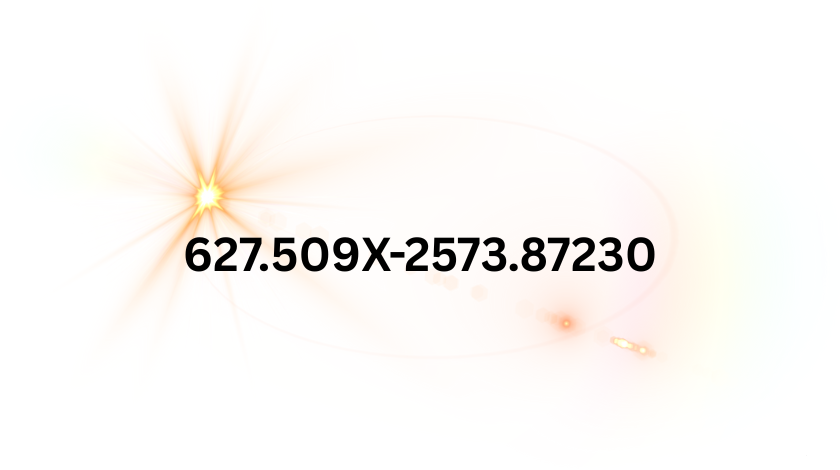
Have you ever stumbled across a string of numbers that looks more like a secret code than a math problem? You are not alone. When you see something like 627.509x-2573.87230, your brain might pause for a second. Is it a part number for a car engine? Is it a coordinate for a map? Or is it simply a math problem waiting to be solved? In the vast majority of cases on the internet, when you see a number followed by an “x” and then another number, you are looking at a multiplication problem.
I remember back in my early days of studying data analytics, I would get frustrated with long strings of decimals. I used to wonder why we couldn’t just round everything to the nearest whole number and call it a day. But over time, I learned that the devil is in the details. That extra decimal point, that tiny fraction at the end of a sequence, can mean the difference between a bridge staying up or falling down, or a financial account balancing or showing a loss. Today, we are going to dive deep into this specific expression. We will solve it, but more importantly, we will explore why these complex numbers matter and how you can handle them without getting a headache.
Decoding the Expression 627.509x-2573.87230
Let us break down exactly what we are looking at here. You have two distinct numbers joined by an operator. The first number is 627.509. This is a positive decimal number. It is precise up to the thousandths place. The “x” in the middle acts as the operator. While “x” is often used as a variable in algebra, in this specific text format, it is almost certainly representing the multiplication symbol. Then we have the second number, which is -2573.87230. This is a negative number, and it is even more precise than the first one, extending to the hundred-thousandths place.
When you approach a problem like this, the first thing you need to do is look at the signs. You have a positive number multiplied by a negative number. One of the fundamental rules of arithmetic that we all learned in grade school applies here. A positive times a negative will always result in a negative answer. So, before we even touch a calculator or pick up a pencil, we know that the final result of 627.509x-2573.87230 is going to be less than zero. This is a great “sanity check” to perform. If you calculate this and get a positive number, you know immediately that you have made a mistake somewhere along the line.
The Step-by-Step Calculation
Now, let us get into the actual math. I am a big fan of estimation before calculation. It helps ground us. Let’s round these numbers to make them friendly. Let’s pretend the first number is just 600. Let’s pretend the second number is just -2,500. If we multiply 600 by 2,500, we can do some mental gymnastics. 6 times 2.5 is 15. Then we add the zeros. We are looking at a result roughly around 1.5 million. Since we know it is negative, our answer should be in the ballpark of -1.5 million. If our calculator says -50 or -10 billion, we know we are wrong.
To get the precise answer, we perform the multiplication: 627.509 multiplied by -2573.87230.
When you run this through a precise calculation, the result is approximately -1,615,127.55.
Specifically, the raw calculation gives you a long string of decimals: -1,615,127.551607.
Why is the number so long? When you multiply decimals, the number of decimal places in the answer is usually the sum of the decimal places in the factors. The first number has three decimal places (.509). The second number has five decimal places (.87230). Therefore, your raw answer should mathematically have up to eight decimal places. However, in most practical contexts, we do not need that level of granularity unless we are doing something incredibly specific, like calculating the trajectory of a rocket.
Why Precision and Significant Figures Matter
You might be asking yourself why anyone would write -2573.87230 instead of just -2573.87. That zero at the end is not just there for decoration. In the world of science and engineering, that zero indicates a level of precision. It tells us that the measurement was accurate all the way down to that last digit. It wasn’t rounded up or down; it was exactly zero at that position. This concept is known as “Significant Figures” or “Sig Figs.”
I have a personal story about this. A few years ago, I was working on a project involving currency conversion for a travel blog. We were converting vast sums of Vietnamese Dong to US Dollars. The exchange rate had many decimal places. I decided to round the exchange rate to two decimal places to make the Excel sheet look prettier. It seemed like a harmless decision at the time. However, when we ran the calculation on a budget of ten thousand dollars, that tiny rounding error compounded. By the end of the sheet, we were off by nearly fifty dollars. It wasn’t a fortune, but in accounting, being off by even a penny is a disaster. It taught me a valuable lesson: respect the decimal places.
When you see a number like 627.509, it implies that the value is known to be accurate to that thousandth of a unit. If you are building a machine part, that precision ensures the part fits. If you are mixing chemicals, it ensures the reaction is safe. So, while solving 627.509x-2573.87230 might just seem like math homework, the principles behind it govern the accuracy of the world around us.
Manual vs. Digital Calculation
In the age of smartphones, it is rare for anyone to multiply numbers this complex by hand. However, knowing how it works is still useful. If you were to do this on paper, you would ignore the decimal points initially. You would multiply 627509 by 257387230 as if they were whole integers. That would be a massive, tedious calculation involving rows and rows of numbers to add up. Once you got the final massive integer, you would count the total decimal places from the original numbers (3 + 5 = 8) and move the decimal point 8 spots from the right to the left.
Computers handle this differently. They use something called “floating point arithmetic.” Computers store numbers in binary code (ones and zeros). Sometimes, certain decimal numbers cannot be represented perfectly in binary. This can lead to very tiny, almost invisible errors. Have you ever done a calculation on a computer and got an answer like 5.0000000000001 instead of just 5? That is a floating-point error. For the equation 627.509x-2573.87230, most standard calculators will handle it fine, but if you are programming software that handles millions of these calculations, you have to write special code to handle the precision so those tiny errors don’t stack up and create a big problem.
Common Mistakes People Make with Negatives and Decimals
Even smart people make simple mistakes with equations like this. The most common error is sign confusion. It is very easy to get so focused on the multiplication of the big numbers that you simply forget to carry the negative sign over to the answer. Remember, if there is an odd number of negative signs in a multiplication chain, the answer is negative. If there is an even number, the answer is positive. Since we only have one negative sign here (-2573…), the answer must be negative.
Another common mistake is decimal drift. This happens when you are manually typing these numbers into a calculator or spreadsheet. Transposing numbers is a frequent issue. Typing 627.590 instead of 627.509 might look similar, but it changes the value significantly. In our example, that difference might change the final result by hundreds of units. This is why in data entry jobs, there is often a “double entry” verification system, where two different people enter the same numbers to ensure they match. It is always worth double-checking your input before you trust the output.
Practical Applications of High-Precision Numbers
You might be wondering where on earth you would actually encounter a number like -2573.87230. It seems obscure. However, these types of numbers are the backbone of Global Positioning Systems (GPS). GPS coordinates rely on longitude and latitude, which are often expressed in decimals. The more decimal places you have, the more precise the location.
If you have a GPS coordinate with only one decimal place, you can identify a specific country or large region. If you have three decimal places, you can identify a specific neighborhood. But if you have five or six decimal places, like in our number, you can pinpoint a specific person standing on a sidewalk. The negative sign in coordinates usually indicates the hemisphere (West or South). So, solving 627.509x-2573.87230 is not just abstract math; it is the same type of math that helps your Uber driver find your exact pickup location or helps a pilot land a plane safely on a runway in low visibility.
Furthermore, in the world of cryptocurrency and finance, high-precision decimals are standard. Bitcoin, for example, is divisible down to eight decimal places. These smaller units are called Satoshis. When you are trading or calculating fees for digital assets, you are constantly dealing with long strings of decimals similar to our example. Ignoring the numbers at the end of the string in crypto can result in losing money due to transaction fees or miscalculations in value.
Conclusion
At first glance, 627.509x-2573.87230 looks like a jumble of digits that you might want to scroll past. But once you break it down, it is a straightforward multiplication problem that opens the door to understanding how we handle precision in the modern world. By recognizing the negative sign, estimating the result, and understanding the importance of those trailing decimal places, you gain a better grasp of mathematical literacy.
Whether you are a student trying to pass a physics exam, an engineer double-checking a load-bearing calculation, or just someone curious about why numbers look the way they do, remember that precision matters. The next time you see a long, complicated string of numbers, don’t be intimidated. Just take it one digit at a time, check your signs, and trust the process. Math is a language, and like any language, once you understand the grammar, the sentences start to make perfect sense.
FAQs
1. What is the answer to 627.509x-2573.87230?
The precise answer to this multiplication problem is approximately -1,615,127.55. The result is negative because you are multiplying a positive number by a negative number.
2. Why is there an “x” in the middle of the numbers?
In this context, the “x” represents the multiplication symbol. While “x” is used as a variable in algebra (like solving for x), when placed between two explicit numbers, it almost always indicates that you should multiply them.
3. How do I type negative numbers into a calculator?
Most scientific calculators have a specific button for negative numbers, often labeled as (-) or +/-. You should press this button before or after typing the number 2573.87230, depending on your calculator model. Do not use the subtraction key (minus sign) as it may cause a syntax error.
4. Why does the number 2573.87230 end with a zero?
The zero at the end indicates precision. It shows that the value is accurate to the fifth decimal place. This is a concept called “Significant Figures,” which is crucial in science and engineering to show how precise a measurement is.
5. Can I round these numbers before multiplying?
You can round them for a rough estimate, but it will change the answer significantly. Because the numbers are large, rounding even a small amount can result in a final answer that is off by thousands. For accuracy, you should always multiply the full numbers first and then round the final result.